Drone filming in Las Vegas: FAA rules, airspace, and how to do it legally.
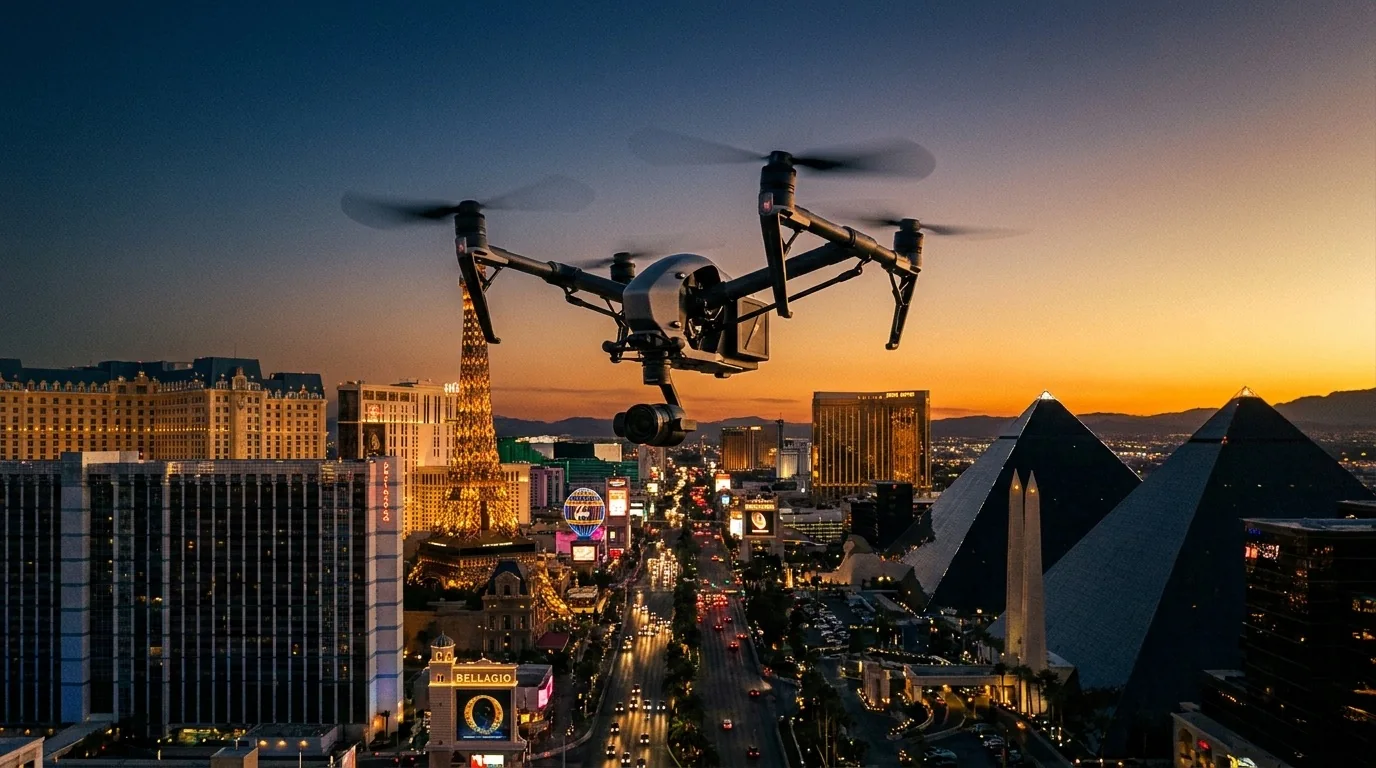
Almost every drone shot of the Strip on Instagram is illegal. Class B airspace, FAA tracks it, and violations carry steep per-incident fines. Here's how to film Vegas from the air legally in 2026: what airspace matters, what Part 107 actually means, and how to hire a drone operator who won't get you grounded.
The airspace map in 30 seconds
Three zones cover most of the Las Vegas Valley and they all matter:
- Class B around Harry Reid International (LAS): the big one. Covers the Strip, downtown, much of the east valley, and parts of west Vegas. Surface to 10,000 ft inside the inner ring. Requires LAANC authorization for any commercial drone flight, usually capped at 50-200 ft AGL by grid square.
- Nellis Air Force Base & the Nevada Test and Training Range: northeast of the valley. Restricted, special-use, and prohibited zones overlap. Don't fly here, period.
- Class D rings: around North Las Vegas Airport (VGT) and Henderson Executive (HND). Also LAANC-controlled.
Outside those zones (Red Rock, parts of Henderson, much of Summerlin's far west) is Class G uncontrolled airspace at low altitudes, Part 107 pilots can fly without separate authorization, but still need certification, registration, and observation rules.
What Part 107 actually means
Part 107 is the FAA rule that governs small commercial drone operations. To fly commercially, meaning any flight whose footage you sell, deliver to a client, post as a paid ad, or use to market your business, the pilot in command must:
- Hold a valid Remote Pilot Certificate (issued by the FAA after passing the Part 107 knowledge test).
- Have the drone registered with the FAA.
- Keep the drone within visual line of sight at all times.
- Fly no higher than 400 ft AGL (above ground level) without special authorization.
- Avoid flying over people and moving vehicles unless the drone qualifies for Category 1-4 operations and the pilot has the right waiver.
- Fly only in daylight or civil twilight unless equipped with anti-collision lighting and trained for night operations.
Violations are tracked. The FAA has investigators in Las Vegas. Major casino-resort properties have their own drone-detection infrastructure and they call it in.
How LAANC airspace authorization works
LAANC (Low Altitude Authorization and Notification Capability) is the FAA's automated approval system. The pilot opens an app (Aloft, Airmap, DJI Fly with LAANC integration), draws the planned flight area on a map, and the system checks the grid against published ceilings.
- If the requested altitude is at or below the grid's published ceiling: approval is automatic, usually within seconds.
- If above the ceiling: the request gets escalated and may take days or weeks. Sometimes denied outright.
- Inside a TFR (temporary flight restriction): no LAANC. You're not flying.
During major events (Las Vegas Grand Prix, fight weekends, presidential visits), TFRs get added around the venue. A good drone operator checks NOTAMs the morning of every shoot.
Permission isn't just FAA, it's the property too
Even with FAA authorization, you still need permission from whoever controls the takeoff/landing site. On the Strip, the resorts are private property, Wynn, MGM, Caesars, Aria, Cosmopolitan, the Venetian all have their own filming policies, security teams, and (in some cases) drone-detection systems. They will eject you and may file a complaint with the FAA.
The right approach: secure the FAA authorization AND the property's written filming permission AND the certificate of insurance the venue requires (usually seven-figure general liability + a drone-specific endorsement). All three. Anything less is gambling with a heavy FAA fine and a ruined shoot.
When drone is worth the add-on, and when it isn't
Drone is available as an add-on per shoot day on your videography quote in Las Vegas. Worth it for:
- Hospitality brand films (showing the property in context with the skyline)
- Outdoor events and festivals (scale shots of crowd / venue)
- Real estate and architectural reveals
- Drone-led B-roll openers for any film
- Wedding ceremonies at outdoor or rooftop venues
Not worth the add-on for tight indoor interviews, podcast-style sit-downs, talking-head content for social, or events at indoor casino ballrooms (no air to fly in). Don't pay for drone you can't use.
Part 107 certified. Insured. LAANC-fluent.
We handle the airspace authorizations so you can focus on the shoot.
Book a Call6 questions to ask before you hire a Las Vegas drone operator
- Can I see your Part 107 Remote Pilot Certificate?
- Show me your commercial drone insurance COI, at least a million dollars in liability.
- Have you filed LAANC for this specific area before? What altitude ceiling did you get?
- What drone model are you flying? (Cinema applications: DJI Inspire 3, Mavic 3 Pro Cine, or comparable. Not a cheap hobby drone.)
- What's the backup if the main drone fails on shoot day?
- Can you send 5+ recent aerial samples in my category, hospitality, events, real estate, whatever applies?
The pilot should be able to answer all six in five minutes. If any answer is vague, hire someone else.
Related guides
- Las Vegas drone laws: where you can fly
- Corporate headshots for your team
- Dallas product photography & video
- Dallas drone videographer: what is actually legal
- Denton video production & live music filming
- Richardson video production & the Telecom Corridor
- Dallas fashion photographer & lookbook video
- Las Vegas hotel & resort photography
- Fort Worth commercial photographer
- DFW trade show & conference video
- Las Vegas event photographer
- Firearms & defense brand content
- Dallas hotel & hospitality photography
- Dallas restaurant & food photography
- How to hire a Las Vegas videographer.
- How much does a Las Vegas videographer cost?
- What to expect on a Las Vegas video shoot.
- How to find an event videographer.